
Tippah County Arrest Records and Court Charges
A Tippah County arrest record is the record of the arrest itself. It marks who was taken into custody, which agency made the arrest, and when booking took place at the county jail. In Tippah County, the Sheriff is the county jailor and keeps a jail docket of people held in custody. That booking side is the arrest record. It does not, on its own, decide what a person is formally accused of. After an arrest, a prosecutor reviews the Tippah County case and decides which charges to file with the court clerk. Those filed charges become the court charge record, and they are what most people are really after when they look up arrest records.
So the two records sit side by side. The arrest record lives on the booking and jail side, and you can read more about the jail docket and booking detail on the inmate records page. The court charge record is what the prosecutor filed and how each count moves through the case. These are the court charges after arrest, tracked count by count until the case ends. The full case file, with pleas, hearings, and the final outcome, sits on the criminal court records page. This page focuses on the arrest-to-charges pathway in between.
How to Find Tippah County Arrest Records and Charges
Tippah County has no single public website that lists arrests and the charges in one place. There is no official online jail roster, and no county charge database open to the public. So the search usually runs as a fallback chain. Start with the agency that holds the part you need, then move up to the court and the state. For the booking side, call the Sheriff at 662-837-9336 and ask about current custody, booking, and bond. For the charge side, the felony index for Tippah County is the Delta Computer Systems Circuit criminal search, which carries Tippah filings from 2008 forward with images.
- Call the Sheriff's office at 662-837-9336 for booking, custody, and bond details, since no online roster exists.
- Open the Delta Circuit criminal index and search by defendant name or case number.
- Open the case and read the charge list to see each count filed against the defendant.
- Check each charge's statute code, severity level, and current status.
For early-stage matters, the charge may not be in Circuit Court yet. Misdemeanor and felony initial appearances run through Justice Court, which has no online case search, so call the Justice Court clerk for affidavit and initial-appearance information. The Delta index notes that the courthouse record is the official one and online data may lag, so confirm anything important with the Circuit Clerk. Contacting the prosecutor's office can also help when a charge decision is pending. You can reach the Third Circuit District Attorney through its contact page to ask which office handles a Tippah case.
The contact directory routes callers to the staff who handle Tippah charges, which speeds up questions about a filing or a court date.
Who Files Charges After a Tippah County Arrest
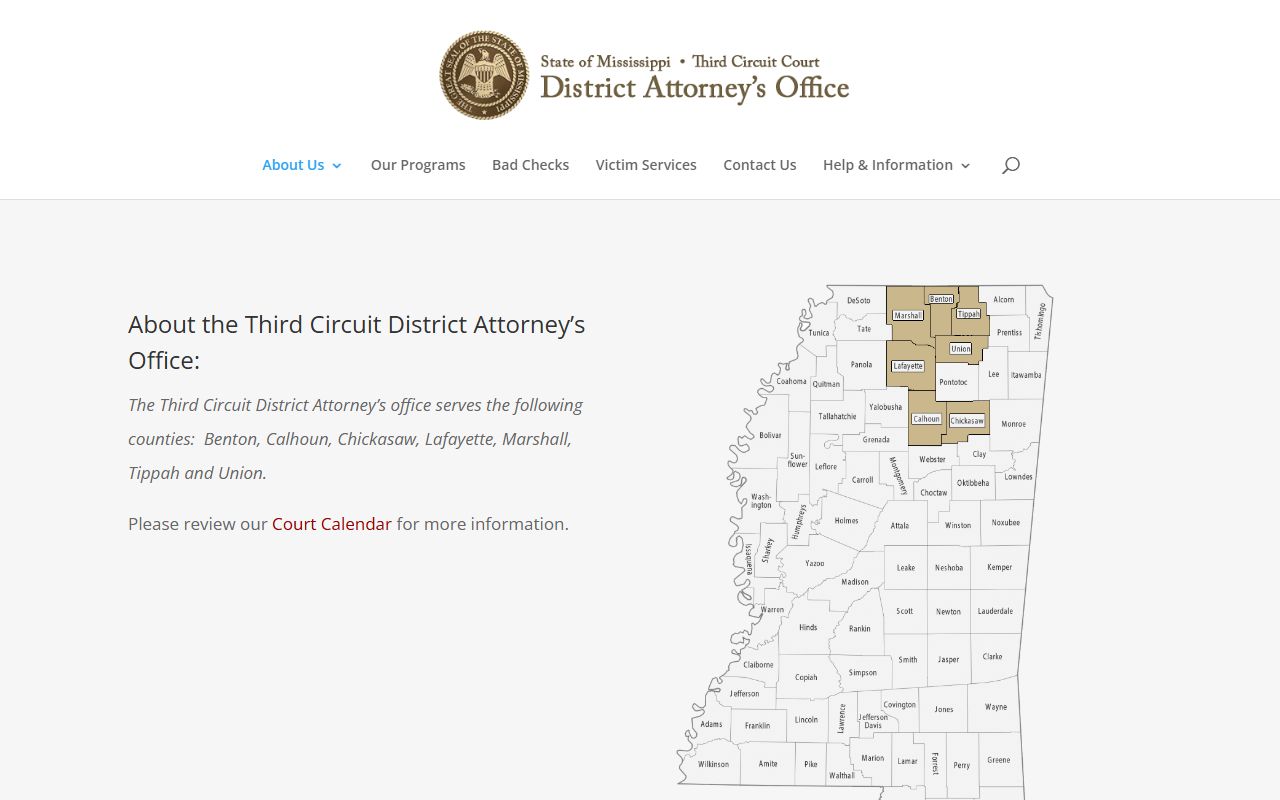
The arresting officer does not set the formal charges. A prosecutor does. For Tippah County felony cases, that prosecutor is the Third Circuit District Attorney, Ben Creekmore, whose office serves Tippah and six neighboring counties. The District Attorney reviews the arrest, weighs the evidence, and decides what to charge, what to reduce, and what to drop. The office also presents serious felony cases to the grand jury for indictment.
You can learn how the office is organized through the Third Circuit District Attorney website, which lists the staff who cover Tippah cases.
Below the felony level, the County Prosecuting Attorney, Bart Adams, represents the state in felony matters before Justice Court, in criminal appeals to Circuit Court, and in misdemeanor youth-court cases. He can also present matters to the grand jury. So a single Tippah County arrest can pass through more than one prosecutor depending on how serious the offense is and which court hears it first.
The path from arrest to charge follows a steady order. Here is the usual flow: Arrest by an officer › Booking and jail docket by the Sheriff › Justice Court initial appearance within three days › Charge review by the prosecutor › Grand jury indictment for felonies › Circuit Court case. Justice Court judges hold sessions at the jail three times each week to protect the right to an initial appearance within three days of arrest. The District Attorney's office also supports crime victims as a case moves forward.
The office's victim services page explains how victims stay informed about charges and hearings in a Tippah case.
How Charges Get Filed: Complaint, Information, and Indictment
In a Tippah County case, the charge record begins when a prosecutor files a charging document with the court. The document names the defendant, lists each count, and cites the statute that was allegedly broken. Three main types are used in Mississippi, and which one applies depends on how serious the offense is and which court will hear it. An arrest can also start with a sworn affidavit in Justice Court before any formal charging document is filed.
| Complaint | Information | Indictment | |
|---|---|---|---|
| Filed By | Officer or prosecutor | Prosecutor | Grand jury |
| Common For | Misdemeanors | Many felonies by waiver | Serious felonies |
| Court | Justice or Municipal | Circuit | Circuit |
| Starts | The case | The case | The felony case |
In Tippah County, many felony matters first reach Justice Court for an affidavit and initial appearance, then move to Tippah County Circuit Court once the grand jury returns an indictment. A defendant may waive indictment and let the case proceed by information instead. The indictment is the document most felony charge records turn on, and the Circuit Clerk files it as part of the case.
Tippah County Charge Codes and Severity
In Tippah County, each charge is tied to a section of the Mississippi Code, and that statute number is the charge code. The code tells you exactly what law was allegedly broken, while a short label describes the offense in plain words. Charges also carry a severity level. A felony is the most serious class and is tried in Circuit Court. A misdemeanor is a lower offense, often handled in Justice Court or Ripley Municipal Court. Some minor violations sit lower still, closer to infractions, and usually carry only a fine.
One Tippah County arrest can produce several separate charges. A single traffic stop, for example, might lead to one count for the driving offense, another for a drug count, and a third for a weapon. Each count gets its own code, its own severity level, and its own status. That is why a charge record often reads as a list rather than a single line, and why a person can be arrested on one charge but face a different set once the prosecutor finishes the review.
Tippah County Charge Status Explained
Charges rarely stay frozen. As a case moves, counts get amended, reduced, added, dropped, or dismissed. The status field on a charge tells you where that count stands right now. Reading the status correctly matters, because a charge that was filed at arrest may look very different by the time the case closes. The table below defines the status terms you are most likely to see in a Tippah County charge record.
| Status | What It Means |
|---|---|
| Filed | The charge has been formally entered with the court and the case is open. |
| Pending | The charge is active and awaiting a hearing, plea, or trial. |
| Amended / Reduced | The charge was changed, often to a lesser offense or a different count. |
| Bound Over | A lower court found probable cause and sent the charge up for grand jury or Circuit Court. |
| Dismissed | The court ended the charge, so it is no longer being pursued. |
| Nolle Prosequi | The prosecutor formally chose not to pursue the charge, dropping it. |
Note: A dropped or dismissed charge can still appear in the public record unless a court later orders it expunged.
Charges vs. Convictions
Being charged is not the same as being convicted. A charge is only an accusation, filed because a prosecutor believes there is probable cause. A conviction comes later, and only if the state proves the case beyond a reasonable doubt or the defendant pleads guilty. Many charges never become convictions. They get reduced, dismissed, or dropped along the way. The comparison below sets the two apart so a Tippah County charge record is read for what it is.
| Charge | Conviction | |
|---|---|---|
| Stage | Accusation | Verdict or plea |
| Burden of Proof | Probable cause | Beyond a reasonable doubt |
| Means Guilt | No | Yes |
| Public Record | Yes | Yes |
Clearing or Expunging Tippah County Charges
Mississippi law lets some people clear qualifying Tippah County charges from public view. The central statute is Miss. Code Ann. Section 99-19-71, which covers expunction. It opens paths for cases where a person was arrested but released, where charges were dropped or dismissed, where there was no disposition, or where the person was found not guilty. It also reaches selected misdemeanors and a few qualifying convictions, with limits. A petition is filed in the court that handled the matter.
The filing venue depends on the case. Use Justice Court for many misdemeanor and traffic-level matters, Ripley Municipal Court for city cases, and Circuit Court for felony matters. If the District Attorney prosecuted the case, that office may receive notice or respond. When a judge grants the order, it directs clerks and agencies to remove or restrict public access to the record.
A separate route to dismissal runs through the District Attorney's Pre-Trial Intervention program. It is open to non-violent felony offenders and lasts one to three years. Participants agree to several conditions:
- Report regularly to the program and pay a supervision fee.
- Submit to drug testing at their own expense.
- Pay restitution to any victims when it applies.
- Stay out of new trouble for the full term.
Finishing the program successfully leads to dismissal of the charges and lets the Tippah County case be expunged. A breach sends the case back to the docket for prosecution. Details appear on the District Attorney's programs page.
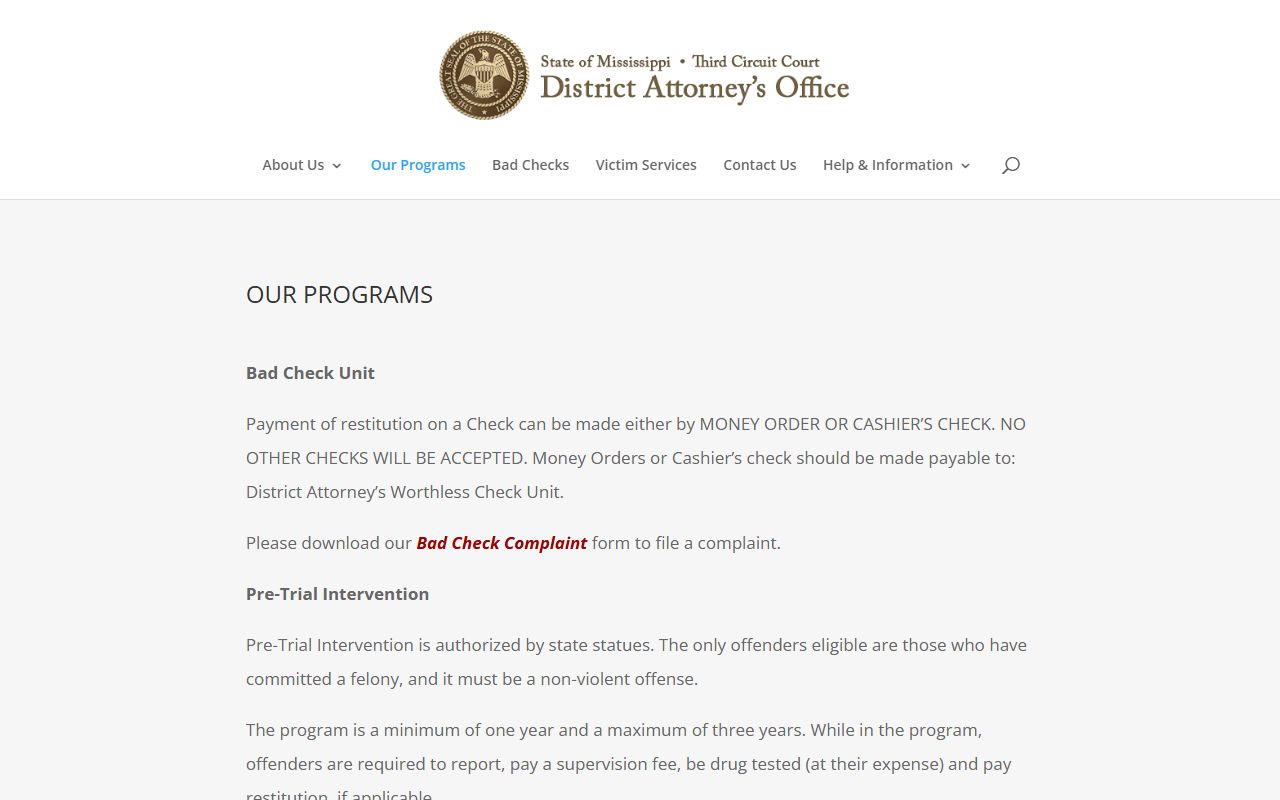
The program page outlines who qualifies and how completion can clear a Tippah County felony charge from the record.
Statewide Charge and Criminal History Lookups
Tippah County charges roll up into a statewide criminal history kept by the Mississippi Department of Public Safety. That history is gathered through the DPS Criminal Information Center, which collects arrest and disposition data from agencies across the state. A full criminal-history record is not a casual public lookup, and access is limited by law to authorized requesters, so most people verify a Tippah County charge through the court index instead.
The same agency runs Crime Stoppers for anonymous tips. If you want to report information about a crime or a wanted person rather than search a charge, the DPS Crime Stoppers line takes tips at 1-888-8CRIMES.

Crime Stoppers handles tips, not record requests, so it complements rather than replaces the court and DPS charge channels.
Background Check Considerations
There is a real gap between a casual charge lookup and a regulated background check. Reading a Tippah County charge index or calling the Sheriff gives you a snapshot, but it is not a screening report. A background check used to decide a job, a lease, or credit must follow the Fair Credit Reporting Act and come from a licensed consumer reporting agency. The Mississippi Bar offers a plain-language explainer on your rights if arrested that helps put a charge record in context.
Important: This site is not a consumer reporting agency under the FCRA, and its information may not be used to decide employment, housing, credit, or insurance.
Restricted Charge Records in Tippah County
Not every Tippah County arrest or charge is open to the public. Youth Court records are confidential by law, so juvenile charges do not appear in the public index. Charges that a court has expunged are removed from public access, and sealed matters stay closed to ordinary searches. Records tied to commitments or sensitive personal data are also restricted or heavily redacted.
The Mississippi Public Records Act draws an important line for law-enforcement files. Under Miss. Code Ann. Sections 25-61-11 and 25-61-12, an incident report is generally a public record, but an active investigative report is exempt. So you may be able to read the basic incident report on an arrest while the deeper investigative file stays closed until a case is resolved. When a record is not in the public index, the right move is to ask the office that holds it, which may release some parts and withhold the exempt ones.