
Criminal Court Records in Tippah County
A criminal court record is the case file a court opens when the state charges someone with a crime. In Tippah County the Circuit Clerk, Phil Koon, keeps the felony files, while lower courts hold the misdemeanor and early-stage papers. The file gathers every official document in one place: the charging paper, bond orders, motions, hearing notes, the plea or verdict, and the final sentence. It is built and updated by the clerk of court, not by the police. For a closer look at the charges themselves, the Tippah County arrest records and court charges page tracks the charging side, while the broader court records index covers every other case type.
Two court levels produce most criminal records here. Justice Court handles county misdemeanors, DUI, and the first appearance after a felony arrest. Circuit Court District 3 takes felony cases once a grand jury returns an indictment or a lower court binds the case over. The Third Circuit District Attorney prosecutes those felonies for Tippah and six nearby counties. Ripley Municipal Court keeps its own file for city misdemeanors and city traffic. Each court holds a separate record set, so one name can appear in more than one place.
The Mississippi Bar offers a plain-English guide to the state court system that maps how these courts connect.
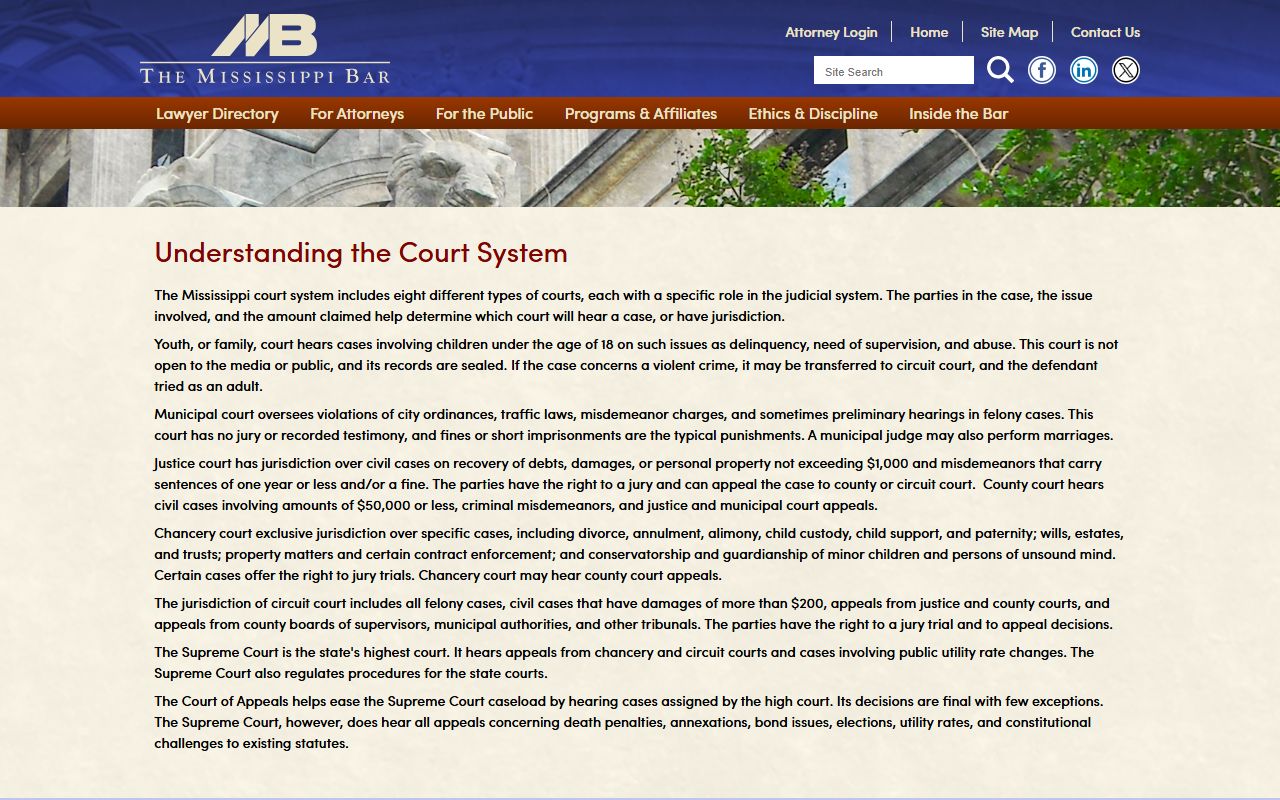
Knowing which court holds a file tells you where to search first and which clerk to call.
How to Search Tippah County Criminal Court Records
The main online index for felony files is the Delta Computer Systems Circuit criminal search. It covers Tippah Circuit criminal cases from 2008 to the present and includes scanned images. Access is by subscription, billed at $30 a month or $330 a year. The vendor warns that the courthouse record is the official one and that online data may lag.
- Open the Tippah Circuit criminal search on the Delta Computer Systems site.
- Search by defendant name, or enter a case number if you have one.
- Narrow the results with a filing date range or the styled plaintiff field.
- Open a case to read the docket entries, charges, and final disposition.
- Request a certified copy from the Circuit Clerk if you need the record for legal use.
Newer filings may run through Mississippi Electronic Courts. Tippah Circuit civil and criminal e-filing became mandatory in February 2025, so recent cases may sit in MEC rather than the older index. A statewide background check runs through the DPS Criminal Information Center, which keeps fingerprint-based criminal history.

That system answers a different question than a single Tippah case file, since it pulls records from across the state. Older or non-imaged cases still require a trip or call to the clerk counter.
Important: Delta search results are an index only, not certified copies; courts and employers usually require a certified record from the Circuit Clerk.
Tippah County Circuit Criminal Search Fields
The Delta Circuit criminal form accepts several search keys. A name search is the most common, but a case or file number returns a single matching record faster. The fields below match the live Tippah Circuit criminal page.
| Field Label | Type | Required | Notes |
|---|---|---|---|
| Defendant Name | Text | Not stated | Primary criminal name search. |
| Case Number | Text | Not stated | Alternative search field. |
| Styled Plaintiff | Text | Not stated | Usually the State of Mississippi. |
| Filed Date | Date | Not stated | Date the case opened. |
| Final Disposition Date | Date | Not stated | Date the case closed. |
| Docket (Book/Page) | Text | Not stated | Locates the paper record. |
| File Number | Text | Not stated | Alternative search field. |
| Use Refinements? | Radio | Optional | Yes or No, applies to name searches. |
| Filing Date Range | Date range | Optional | From and to dates. |
Stages of a Tippah County Criminal Case
A criminal case moves through fixed steps, and each step adds a layer to the record. After arrest, a person gets a first appearance in Justice Court, often within three days, since judges hold jail sessions three times a week. Felonies then move to Circuit Court for indictment and trial-level handling. The record grows at every step.
Case flow: Charges Filed › Arraignment › Pretrial and Motions › Plea or Trial › Disposition › Sentencing
- Arraignment
- The defendant hears the charges and enters a plea of guilty, not guilty, or no contest.
- Pretrial and Motions
- Lawyers file motions, exchange evidence, and argue bond or suppression issues.
- Plea or Trial
- The case ends in a negotiated plea or goes to a jury for a verdict.
- Disposition
- The clerk records the outcome, whether a conviction, dismissal, or acquittal.
- Sentencing
- After a guilty finding the judge orders the punishment and any conditions.
The Mississippi Bar also explains a defendant's rights after arrest, including bond and the right to counsel.
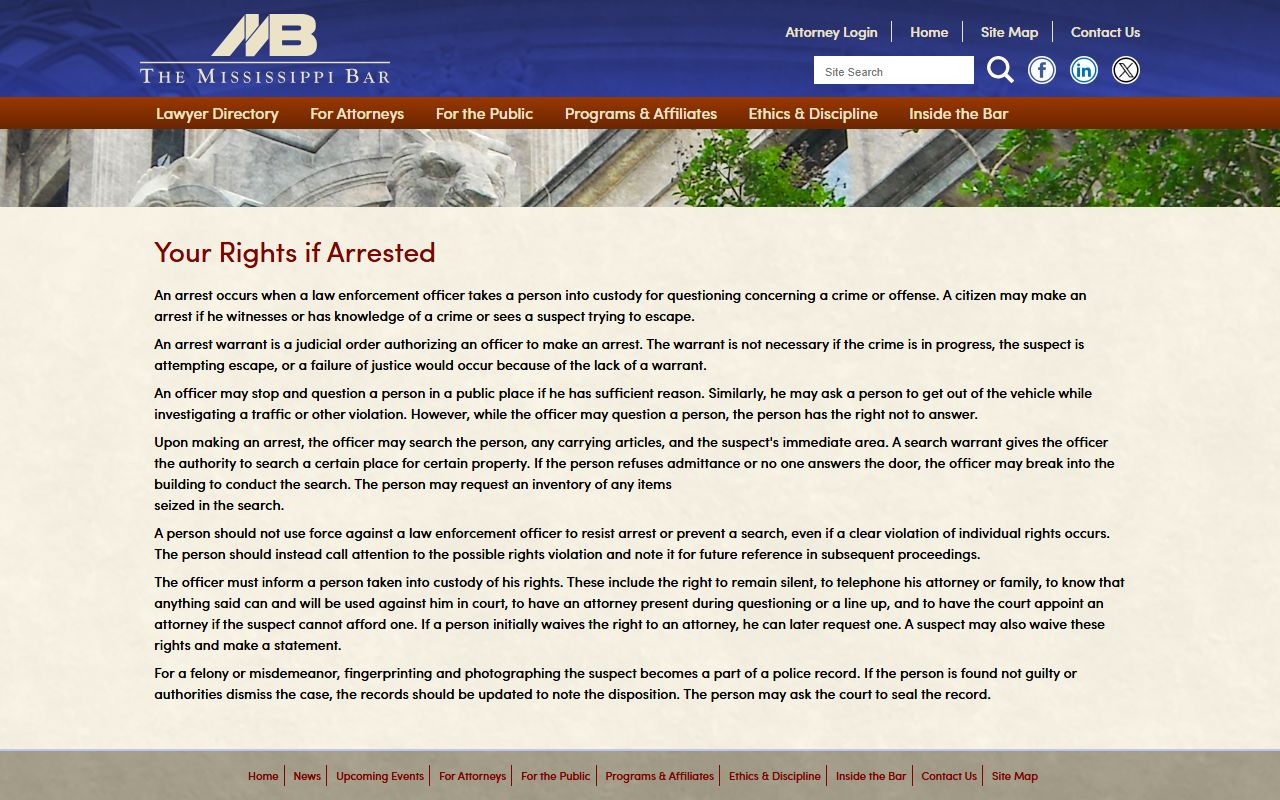
Those early decisions, from bond to the entry of a plea, all leave entries in the case file.
Note: A felony may appear in Justice Court for an initial appearance long before any indictment is filed in Circuit Court.
What a Tippah County Criminal Court Record Shows
The case file pulls together fields that track the charge and its outcome. The same fields drive the online index and the paper file at the clerk counter. Each field reads in plain terms below, from the case number that opens the file to the sentence that closes it.
| Field | What It Shows |
|---|---|
| Case Number | The unique number the clerk assigns when the case opens. |
| Defendant | The person charged, listed by name in the criminal index. |
| Charges | The specific crimes filed, by statute and degree. |
| Plea | How the defendant answered: guilty, not guilty, or no contest. |
| Disposition | The final result, such as conviction, dismissal, or acquittal. |
| Sentence | Any prison, jail, probation, fine, or restitution ordered. |
| Filed and Disposition Dates | When the case opened and when it closed. |
Reading Tippah County Dispositions and Sentences
The disposition is the bottom line of the case. A "guilty" entry means a conviction by plea or verdict. "Not guilty" means an acquittal at trial. "Dismissed" or "nolle prosequi" means the state dropped the charge. "Nolo contendere," or no contest, accepts the penalty without admitting guilt. Reading the disposition first tells you how the case actually ended.
The sentence follows a conviction. It can list prison or jail time, probation, a fine, restitution, or a mix of these. Some defendants enter the Third Circuit District Attorney's Pre-Trial Intervention program, a one-to-three-year supervised track for non-violent felonies. Finishing it leads to dismissal and possible expunction. Breaking the terms sends the case back to the docket for prosecution.
Charges vs. Convictions
Being charged is not the same as being convicted. A criminal court record often lists charges that were later dropped, dismissed, or that ended in an acquittal. Reading a file correctly means separating the accusation from the result.
| Charge | Conviction | |
|---|---|---|
| Stage | Formal accusation | Verdict or guilty plea |
| Burden of Proof | Probable cause | Beyond a reasonable doubt |
| Who Decides | Prosecutor files it | Judge or jury finds it |
| Public Record | Yes | Yes |
| Meaning | Case is pending or alleged | Guilt established by the court |
Public Access to Tippah Criminal Records
Most criminal court files in Tippah County are open to the public. The Mississippi Public Records Act treats government records as available unless another law closes them. Court files also follow court rules and any sealing order a judge enters. To get a copy, route the request to the office that holds the record, which for felony files is the Circuit Clerk. Expect redaction of exempt material and a cost estimate when staff time is needed.
Key Statutes:
Miss. Code Ann. § 25-61-1 - public records are generally open unless another law says otherwise.
Miss. Code Ann. § 25-61-5 - gives the right to inspect and copy public records, usually within seven working days.
Sealed vs. Expunged Records
Two legal tools can pull a record out of public view, and they work differently. A sealed record still exists but is closed to general inspection. An expunged record is treated as if it never happened. Mississippi sets the rules for clearing a record in Miss. Code Ann. § 99-19-71, which covers dismissed charges, not-guilty findings, and some qualifying convictions.
| Sealed | Expunged | |
|---|---|---|
| Visibility | Hidden from public view | Treated as never existed |
| Law Enforcement | Limited access remains | Very limited access |
| Eligibility | Set by court order and statute | Dismissed, dropped, not-guilty, or qualifying cases |
| Where to File | The court that handled the case | The court of conviction or arrest |
Note: Expunction is granted by petition, and Tippah's courts do not publish the forms or fees online, so confirm the process with the clerk.
Restricted Criminal Court Records in Tippah County
Some criminal records never reach the public index. Youth Court files are confidential by law and sealed from public search. Adoption and mental-health commitment files, which run through Chancery Court, are also closed. Ongoing investigations can stay out of view, since investigative reports are exempt even when the related incident report is public.
Personal data like Social Security and account numbers, victim details, and minor identities are redacted before release. When an index search returns nothing, the case may be sealed, may sit in another court, or may simply predate the digital records.
- Youth Court delinquency and abuse-neglect files (Miss. Code Ann. § 43-21-251)
- Sealed and expunged criminal cases
- Adoption and mental-health commitment files
- Law-enforcement investigative reports
- Redacted personal identifiers and victim information
Tippah County Criminal Case Attorneys
Two sides shape a Tippah felony case. The Third Circuit District Attorney, Ben Creekmore, prosecutes for the state across seven counties, including Tippah. The County Prosecuting Attorney, Bart Adams, represents the state in felony matters before Justice Court and in criminal appeals to Circuit Court. Defendants who cannot afford a lawyer may receive an appointed public defender, whose name appears in the case record as the matter moves forward.
The Third Circuit District Attorney lists its Tippah-assigned attorneys and staff online.
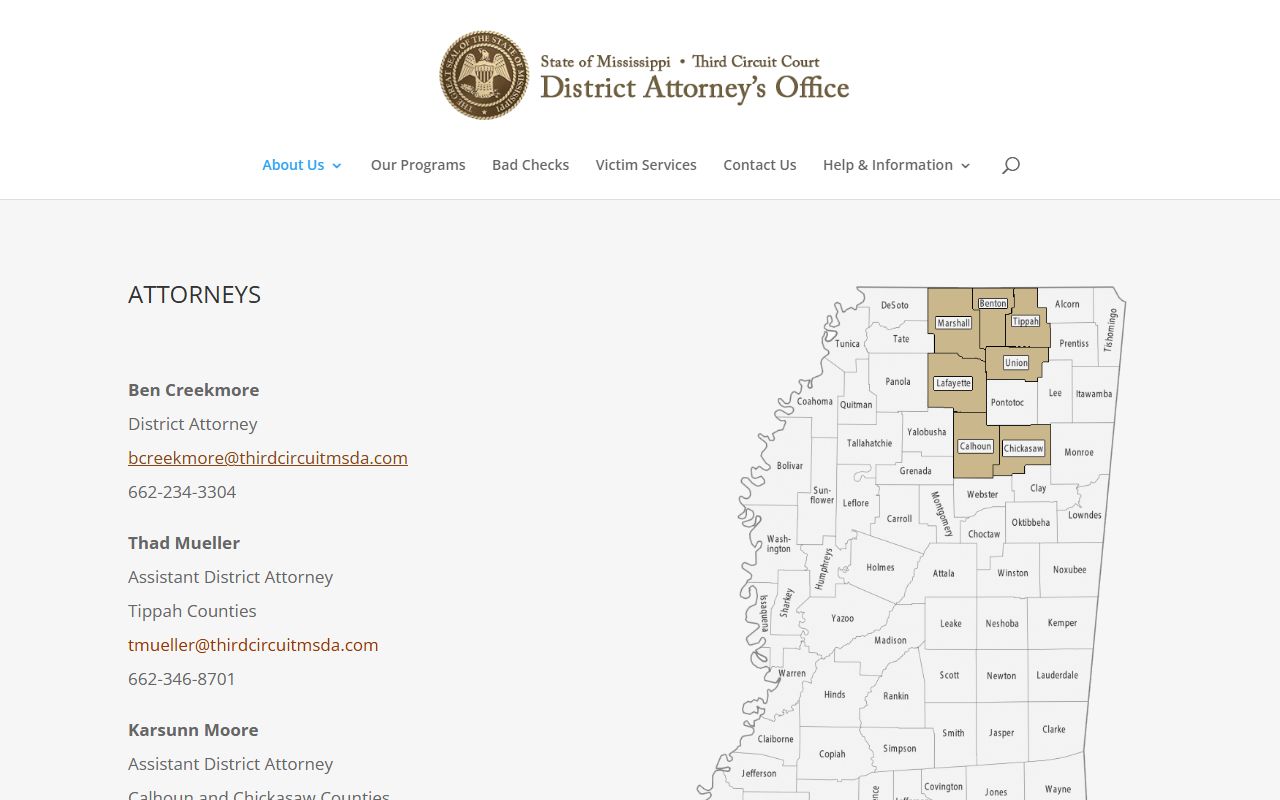
Assistant District Attorney Thad Mueller and a county investigator handle much of the felony caseload from the New Albany office.
Third Circuit District Attorney
Ben Creekmore
300 North Lamar Blvd., Suite 207
Oxford, MS 38655
662-234-3304
For appointed counsel, the Mississippi Office of State Public Defender keeps a county directory.
The Mississippi Office of State Public Defender directory helps locate appointed counsel by county.
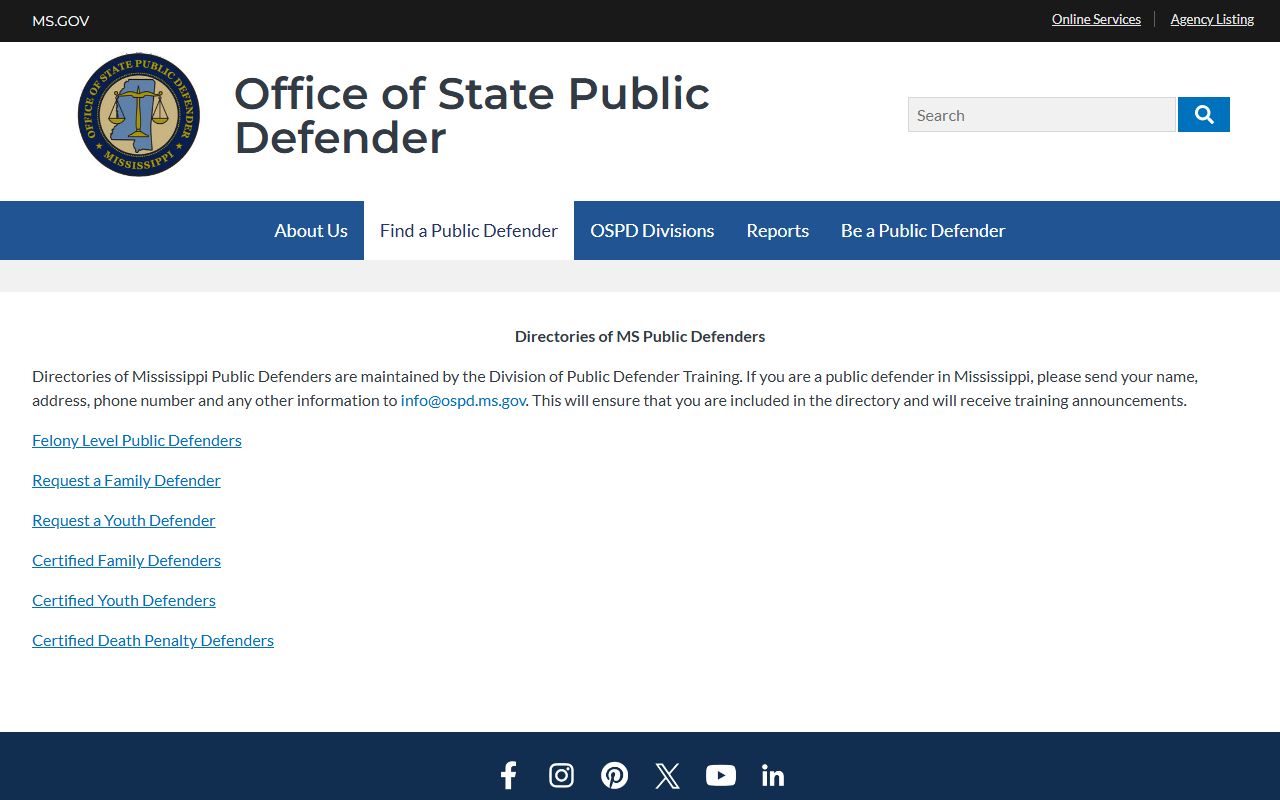
Tippah's felony defender list names local attorneys who take court-appointed cases.
Tippah Felony Public Defenders
Christopher E. Kitchens, 114 South Commerce St, Ripley, MS 38663, 662-837-0099
Paul Mason Wages, 110 E. Main Street, New Albany, MS 38652, 662-266-3337
Background Checks and Tippah Criminal Records
A casual record lookup is not the same as a formal background check. Court files and the DPS Criminal Information Center show charges and dispositions, but a regulated background check for hiring or housing must follow federal law. The Fair Credit Reporting Act sets rules that ordinary public-record searches do not meet.
Important: This site is not a consumer reporting agency under the Fair Credit Reporting Act, and its information cannot be used for employment, tenant, credit, or insurance decisions.